
How it works

How we make your business easier for AI to find and cite

We research the questions people search in your service area that Google’s AI answers don’t yet cover well, build one consistent record of your business, back it up with real listings, reviews, and people, and publish it in a resource library and across a 9-node data network — all pointing back to your official website as the source of truth. Everything we do is below, grouped by what it is for. Weekly and monthly monitoring is coming soon.

By AI Visibility Solutions

How the work is organized

Four phases, one consistent record

Most of this work happens on properties we operate, because we usually do not have access to a client’s website. If access is given, we can also add files or articles on the official site. If it is not, the rest of the work still proceeds. The official website remains the source of truth either way.

1

Foundation

A single, consistent record of the business is published in the places search and AI systems use to recognize it.

2

Authority

Professional listings, real reviews and testimonials, and team bios are added, and that proof is folded back into the resource library.

3

Content reach

A larger body of useful, original content is published, with each piece unique to where it appears and pointing back to the official website and resource library.

4

Visibility and monitoring

We check where the business is already being named, and we use those findings to widen accurate mentions, with a report the client can read.

Research

Research

Before anything is published, we build one confirmed picture of the business and find the questions customers ask that are not yet answered well.

Our lead research

Unanswered-questions research — every service, every city you serve

We research the questions people search in your service area that Google’s AI answers don’t yet cover well — and, when you connect it, we use Search Console data too.Coming soon

Today the work is a research pass on each service across each city you serve, confirmed with live Google checks of AI Overviews, featured snippets, and People Also Ask. Search Console is coming soon: it needs your permission, and we add it only when you connect your account.

  1. 1

    Start from your real services

    We list every service you offer, and the smaller jobs under each one, from your own website and the work you most want to be known for.

  2. 2

    Add every city you serve

    We run the research for the cities and surrounding areas you actually serve — not just the town your office is in.

  3. 3

    Find what people actually ask

    For each service in each area, we collect the questions homeowners or clients really ask, including the follow-up questions that appear as “People also ask.”

  4. 4

    Check live Google results

    For each question, we check whether Google already shows a complete AI Overview, a featured snippet, or a People Also Ask answer in your area — and which sources it cites.

  5. 5

    Prioritize the gaps

    Questions with no AI Overview, or a generic one that does not name or cite you, come first. Questions that already have a complete, trusted answer are weaker targets.

  6. 6

    Write, approve, publish

    We write a clear, specific answer from your real services, your area, and your approved facts. You review it, and we publish it as a Q&A in your resource library.

What you get

A reviewed set of real customer questions with clear, local answers, published in your resource library. Nothing is published until it is reviewed and approved, and we do not mass-publish near-duplicate questions.

Search Console dataComing soon

When you connect Google Search Console, we also use the queries and pages from your own search data to find gaps we would otherwise miss.

Why it matters: Where Google’s AI answers are missing, generic, or do not mention your business, a clear, specific, local answer is most useful to the customer — and gives AI assistants a source they can read and cite. We cannot promise any question will appear in an AI Overview or answer.

Onboarding research: getting the record right

The first pass, before anything is published.

  • Public-record pass

    We start with what is already on the public record about you: official name, address, phone, hours, service area, licenses, owner or team, and how you are described online. Anything unconfirmed stays in a private note, not on your public profile.

    Why it matters: Every later page uses the same confirmed facts, so AI assistants are not left to reconcile conflicting details.

  • Your services, narrowed to your priorities

    We read the services on your own website, review the profile details we gathered, and correct them. Then we narrow the work to the services you most want to be known for.

    Why it matters: The public record reflects the work you want, not a generic category.

  • Micro-services that lead to bigger jobs

    We break each main service into the smaller jobs customers ask about — often the question that comes first, before a larger project.

    Why it matters: People rarely search for a headline service name. Matching how they actually ask makes an answer easier to find and match.

  • Specialties

    We build a complete list of your specialties so search and AI systems can read the exact kinds of work you do.

    Why it matters: A specific specialty is easier to match to a specific question than a broad category.

  • Owner and team bios

    We research and write a professional bio for the owner and for each team member you agree to name, using only facts we can confirm, and you approve them before they are published.

    Why it matters: Named, credentialed people make a business easier to trust and to describe accurately.

  • Full business description, including hours

    We write one complete, accurate description of the business — what you do, who you serve, where, and when you are open.

    Why it matters: It becomes the plain-language source that every profile, page, and file draws from.

  • Genuine profiles, listings, and directories

    We find your real public profiles, listings, citations, and directory links, and keep only the genuine ones. We never treat our own libraries or directory pages as third-party proof.

    Why it matters: Independent, consistent mentions are what let AI systems confirm the business is who it says it is.

  • Client intake form

    New clients provide a single, consistent record of the official name, address, phone, hours, services, and website, so the public profile is built from confirmed facts. Anything still unconfirmed stays private, not on the public profile.

    Why it matters: One confirmed record at the start prevents conflicting details later.

  • Profile details from the official website

    We read your own website to pre-fill profile facts, then review and correct them before anything is published.

    Why it matters: Starting from your own site keeps the record aligned with the source of truth.

Ongoing research: keeping up with your customers

  • People Also Ask and community questions

    We collect the follow-on questions people ask — the ones that show up as “People also ask,” and the ones customers discuss on well-known Q&A and community sites — and we write answers for the ones that match your services and your area. We do not copy other people’s answers.

    Why it matters: These are the questions customers ask next, so they are the ones worth answering clearly.

  • Gaps versus what competitors cover

    We look at which questions competitors already answer, and which ones they leave open, so the content we write is aimed at the gaps.

    Why it matters: A clear answer to a question nobody answers well is more useful than one more copy of an answer everyone has.

  • Sourced background research

    We gather published, source-backed background on your topics so later articles and guides are written from real information, not invented facts. When a reliable statistic is relevant, we include that figure, with its source.

    Why it matters: Sourced facts make the library more useful to readers and to AI systems that look for a clear origin.

  • Additional phrases customers use

    We look for the extra phrases and questions people use when they look for your services, so the content can match the way customers actually ask.

    Why it matters: People often search in words that are more specific than a service title.

  • Content and page opportunities

    We review your current profile and site coverage and flag missing pages, topics, or service-area subjects that are not yet represented, so you can decide what to add. We do not invent services you do not provide.

    Why it matters: It turns gaps in the public record into a clear list you can act on.

  • Monthly trending-query researchComing soon

    Each month, we look again at the questions people are asking about your services, so new FAQs and articles follow what customers are searching now.

    Why it matters: Customer questions change. The record should keep up.

Foundation

Foundation

We build one consistent record of your business and publish it where search and AI systems look — all pointing back to your official website as the source of truth.

The record

  • One complete business profile

    A single profile holds your name, website, contact details, locations, cities served, services, team, description, hours, and your genuine profile links. Saving the profile also starts a few structured files; the rest are built in the steps below. The profile is the source of truth for everything we publish.

    Why it matters: AI assistants repeat what they can find and verify. One consistent record makes accurate answers more likely.

  • Secure client login

    You get a private workspace for your business, with a secure login and a way to reset a forgotten password.

    Why it matters: Your record and drafts stay in a workspace only you and the team can use.

  • Services list

    We organize your real services into a clear, categorized directory that can be published, so people and AI systems can see what the business actually does. We never add services you do not offer.

    Why it matters: A clear list of real services is easier to match to a customer’s question.

  • A record that grows with you

    As your business grows, we add new cities, services, locations, Q&As, and team members to the same profile, and publish the additions to your library.

    Why it matters: Your public record stays complete as you do.

Where it lives

Everything points back to your official website as the source of truth.

  • Resource Library for AI Systems

    Your own Resource Library for AI Systems, published on Cloudflare — FAQs, guides, and more, on its own web address (usually an aiovisibility.net subdomain, or a subdomain of your own domain if you give us DNS access). Every page points back to your website.

    Why it matters: It gives AI assistants and search systems a clean, public place to read your information, even if your website cannot host these files.

  • AI discovery files in the library

    Each library includes machine-readable files — an llms.txt summary, sitemaps, a knowledge graph, and structured data for your organization, services, locations, and team.

    Why it matters: They state your facts in a form machines read directly, instead of leaving them to infer from page text.

  • AI-Crawlable Data Site

    The AI-Crawlable Data Site, hosted on GitHub Pages — a structured-data site on its own address, with the structured files behind it kept in a public repository as a permanent source. It points back to your official website.

    Why it matters: A second, independently readable place for distinct information about the business, that does not depend on your website’s setup.

  • Directory profiles

    Each client gets a full profile on aibizprofile.com and on aiovisibility.net, with a comprehensive description, a full services list, links to your genuine third-party profiles, a link to your resource library, and structured data.

    Why it matters: Complete, consistent profiles give assistants another place to confirm who you are and what you do.

On your own website, when you give access

Most of our work happens on properties we operate. If we are not given access to your site, the rest of the work still goes ahead.

  • AI-readable files for your website

    We prepare the machine-readable files that sit at the root of your website — a short summary, a fuller context file, sitemaps, and structured data for your organization, services, locations, and team — and, when you or your developer give us access, we add them without changing how the site looks.

    Why it matters: Your own site then states the same facts as your library, so assistants see one consistent story.

  • Page-level recommendations and structured data

    We review pages on your site and suggest on-page text and structured markup, page by page. With access, we add per-page structured data ourselves.

    Why it matters: Each page then says clearly what it is about, who wrote it, and where you operate.

  • Help getting published files live

    We help get your published files live. You can reach us by phone or email — the same contact details already on this site.

    Why it matters: The record only helps if it is actually published and reachable.

The 9-node data network

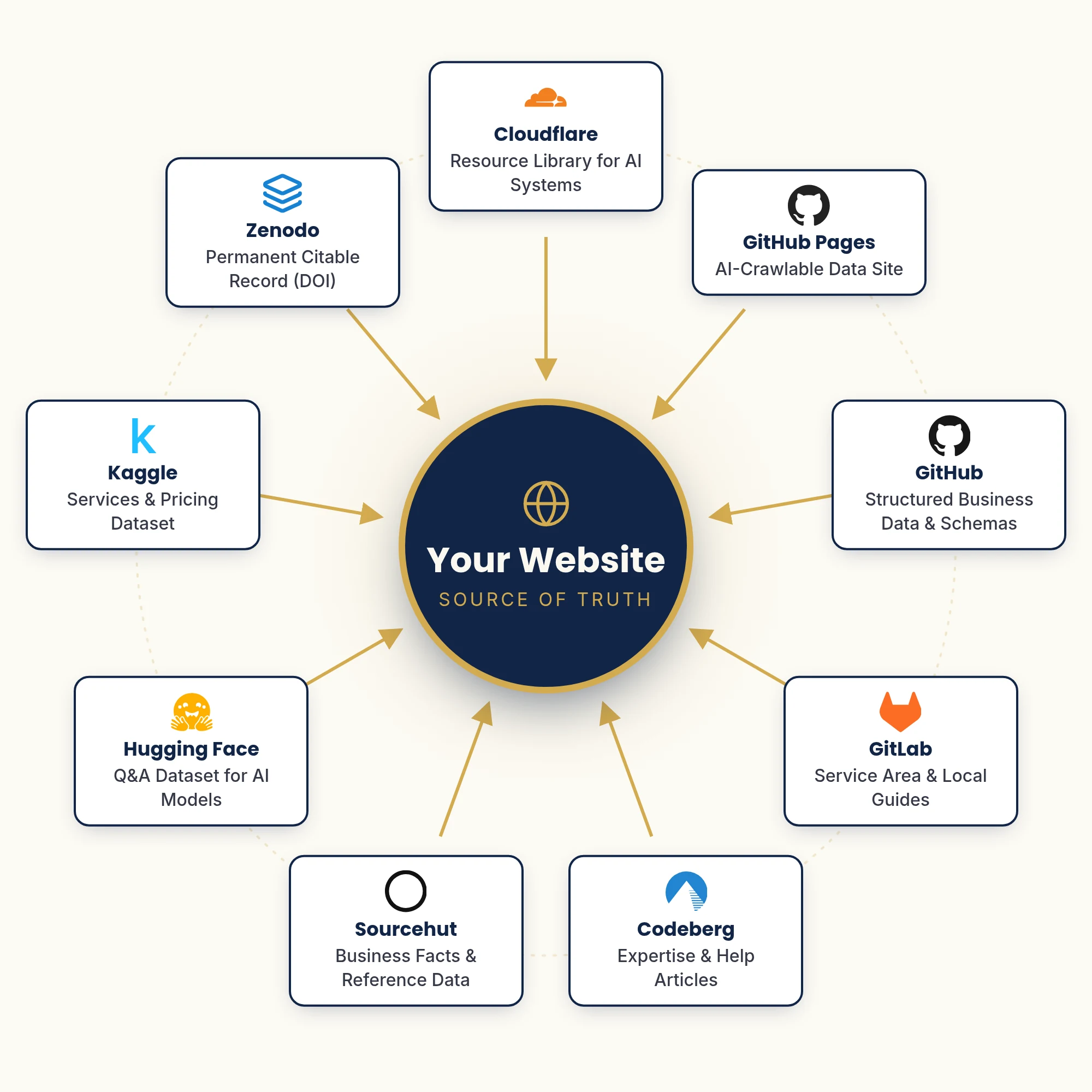
Each of the nine public nodes publishes distinct information about the business, all pointing back to the official website as the source of truth. This is one part of the service — not the whole of it.

The 9-node data network, with Your Website as the source of truth at the center, Cloudflare as the Resource Library for AI Systems, GitHub Pages as the AI-Crawlable Data Site, and GitHub, GitLab, Codeberg, Sourcehut, Hugging Face, Kaggle and Zenodo around it, each pointing back to the official website
Cloudflare publishes the Resource Library for AI Systems, with FAQs, guides, and more. GitHub Pages hosts the AI-Crawlable Data Site, and GitHub stores the structured files. Google-owned Kaggle, plus GitLab, Hugging Face, Codeberg, Sourcehut and Zenodo, each publish distinct information about the business, creating an authority network across the web that enhances your entity recognition for AI systems.

GitHub

A public repository of structured files — a permanent source used to build the Resource Library’s guides, FAQs, and more.

AI-Crawlable Data Site

A structured-data site on GitHub Pages, so search and AI systems can read distinct information about the business even when the official website cannot host these files. It stands on its own address and points back to the official website.

Resource Library for AI Systems

FAQs, guides, and more, published on Cloudflare, with every page pointing back to the official website.

GitLab

A second public home that publishes distinct information about the business, pointing back to the official website.

Kaggle

A Google-owned data platform that publishes distinct structured information about the business.

Hugging Face

A widely used public home for structured datasets with distinct information about the business.

Codeberg

A public code-hosting platform that publishes distinct, independently hosted information about the business.

Sourcehut

A public repository platform that publishes distinct structured information about the business.

Zenodo

A research repository that publishes distinct information about the business.

Example discovery files

These redacted examples show the kind of machine-readable files that go into a library and data site. Client-identifying details have been removed.

Authority

Authority

We back the record up with real, independent proof — genuine listings, real reviews, and real people — and we never invent any of it.

Listings and citations

  • Citation and listing work

    We audit your existing listings, then claim, update, or create the professional and local listings that fit your business — or document why one is not a fit. We focus on free or already-paid listings you already have or can claim.

    Why it matters: Matching, independent listings let AI systems confirm the same facts from more than one place.

  • Name, address, and phone consistency

    We correct inconsistent names, addresses, and phone numbers across your library, directory profiles, and the listings we can edit — or ask you to edit.

    Why it matters: Conflicting details are one of the quickest ways for an assistant to describe a business wrongly, or skip it.

  • Google Business Profile and other core listings

    We review your Google Business Profile and recommend improvements. We also review Bing Places, Apple Business Connect, and the ChatGPT business profile, recommend corrections, and help you claim a listing or give you a claim guide when we cannot access the account ourselves. We do not manage these profiles day to day.

    Why it matters: These are the listings assistants and maps already lean on for local businesses.

  • BBB and chamber recommendations

    We check whether a BBB profile or local chamber listing exists, recommend claiming or joining where it helps, and prepare the materials. Any dues are your choice and your cost. We do not invent memberships.

    Why it matters: Recognized local organizations are credible, independent places to be listed.

Real proof from real customers

  • Real reviews and testimonials

    We find real customer reviews already posted about your business, keep the original wording and a link to the source, and add only the reviews you approve to your resource library. We never write testimonials, offer incentives for ratings, or use reviews we cannot source.

    Why it matters: Real customer words are credible proof, and assistants can read them.

  • Real case studies

    When you share real past projects or matters and give us permission, we turn them into case studies in your library. We never invent a case study.

    Why it matters: Specific, true examples show the work you actually do.

  • Team and owner bios in your public profiles

    Approved bios go into your library and directory profiles with the role and credentials you have confirmed. For a law firm, attorney profiles are built the same way.

    Why it matters: Named, credentialed people make the business easier to trust — and to describe correctly.

  • Proof folded back into the library

    As reviews, bios, and listings are confirmed, we add them to your resource library and profiles, so the record gets stronger over time.

    Why it matters: The proof sits next to the facts it supports, in one place.

A closer look at the record

  • Authority Suite and the AI Visibility Score

    A set of optional tools for looking more closely at your topics, trust signals, content gaps, and related strengths. One of the tools, the AI Visibility Score, rates your current setup and gives a score. That score is a review of the setup, not a measure of AI citations.

    Why it matters: It shows where the public record is already strong, and where it could still be fuller.

Content

Content

We write clear, unique answers and guides that point back to your official website.

  • FAQs and Q&A pages

    We write clear FAQs for the services and topics your customers ask about in your area, and publish a focused, useful set in your resource library — not a huge stack of near-duplicate questions.

    Why it matters: A focused set of useful answers reads as original help, not filler.

  • Help articles and guides

    Practical how-tos, guides, checklists, comparisons, “when to call” pieces, mistakes to avoid, myth versus fact, and Q&As, about your services in the cities you serve. Each is a unique, useful page that points back to your website. We do not create a separate template page for every service in every city.

    Why it matters: Different customers need different kinds of help, and each format answers a different kind of question.

  • Ongoing articles

    Regular, original articles on properties we control — and on your own site when you give access. Every piece is unique and useful, and links back to your official website and resource library.

    Why it matters: Steady, original publishing keeps the record current and widens where accurate information about you appears.

  • Topic pages for AI and search

    We create longer topic pages, grounded in your own site and profile, that can be published in the resource library and point back to your official website.

    Why it matters: A fuller page on a real topic gives assistants more of your own, consistent information to read.

  • The business’s own voice

    If you have brochures, guides, notes, or other materials that show how you speak to customers, we can use those so later FAQs, articles, and pages are written from that material and in that voice.

    Why it matters: New pages then sound like your business, not a generic description of the trade.

  • Articles for your publishing channels

    We can draft original articles, each with a different role and a link back to your official site or resource library, for publishing on channels you use. This is not an always-on autopublisher — every piece is reviewed before it goes live.

    Why it matters: Original articles in more than one place can still point back to one official record.

  • Additional article drafts for other sites

    We can also write a unique draft for other publishing sites you choose — for example a longer article, a newsletter issue, or a short guide — each with a link back to your resource library. Every piece is reviewed before it goes live. We do not publish you on a fixed list of sites.

    Why it matters: Each draft can be written for the place it will appear, without copying the same article everywhere.

  • Social posts drafted from published articles

    We can turn already-published articles into draft social posts for you to review and post. Nothing is posted or scheduled automatically.

    Why it matters: A draft from a published article keeps the public message consistent, and you stay in control of what goes out.

  • Short videos from approved articles and Q&AsComing soon

    For each approved article or Q&A, we can make a short video — with a clear title, description, and tags pointing back to the article — and publish it on a channel you own, or on an AI Visibility Solutions channel if you prefer.

Technical and schema

Technical and schema

We add structured data so search and AI systems can reliably identify the business, its people, its services, and its answers. If we are not given access to your website, the same schema still lives on the resource library and the AI-Crawlable Data Site.

  • Business and service schema

    We mark up the organization with the correct business type, plus services, offers, address, hours, and service area. We also create structured data for each of your main services.

    Why it matters: AI systems can read what you offer, where, and how to reach you.

  • FAQ, Q&A, article, and how-to schema

    Question-and-answer pages, articles, and how-to guides include structured data, with speakable markup so voice assistants can read the answer aloud.

    Why it matters: Answers are labeled as answers, so they are easier to lift accurately.

  • Person and team schema

    We mark up team members — and attorneys for law firms — with role, expertise, and the credentials you have approved.

    Why it matters: It connects a named, credentialed person to the work.

  • Review, location, and page-structure schema

    When real reviews and a clear page structure exist, we include review, breadcrumb, and location markup. We never invent ratings.

    Why it matters: It shows where you work and what real customers have said.

  • Per-page schema on your website

    When you give us access, we add per-page structured data to your own site. If you do not, the same types of schema still live on your resource library and the AI-Crawlable Data Site.

    Why it matters: Every page tells crawlers the details they need.

  • HTML guide and Q&A pages

    We build HTML pages from approved FAQs, Q&As, and help articles — including a ready-to-paste page for your own website, and HTML pages for the guides and Q&As in your resource library and on the AI-crawlable data site.

    Why it matters: People and AI systems can read the same approved answers as webpages, on your site or in the library.

  • Automatic search-engine notification of changes

    When published pages change, search engines are notified automatically so they can pick up the updates. A notice does not guarantee a page will be indexed.

    Why it matters: Updated pages can be found sooner. Indexing itself is still decided by the search engine.

Checks and reporting

Checks, reports, and monitoring

We check how your business shows up today, and tell you plainly what to do next. Weekly and monthly monitoring is coming soon.

What we do today

  • AI visibility checks, with screenshots

    We ask real customer questions of major AI assistants and record whether your business is named, who else is named, and what the assistant says, with screenshots. These are dated, point-in-time checks, and AI answers change.

    Why it matters: It shows where the record is working, and where it still needs work.

  • Web-mention research

    We run research questions against live web search to see where your business, website, and topics already show up on public pages. This is web-search research, not a measure of what AI assistants say.

    Why it matters: It shows where mentions are thin, outdated, or inconsistent.

  • Visibility gap review

    We review what is still missing — pages, phrases customers use, and local coverage you could still address — and recommend what to add next, so you decide what goes in.

    Why it matters: It turns what we find into a plain next-step list.

  • Renewal and progress reports

    A readable report of what was delivered, with live links to the pages, libraries, and profiles, and what we recommend next.

    Why it matters: You can see exactly what exists and where.

Tracking, visibility, and refresh

  • Citation tracking

    We check whether major AI assistants name or cite the business, and keep a record over time. This is not a measured-citation report a client already has.

  • Search visibility monitoring

    We review how the business appears in search, so we can see search visibility over time. This is not an analytics report a client already has.

  • AI crawler activity on the resource library

    We watch how AI systems request pages on the resource library, so we can see when the library is being read. This is not a traffic report a client already has.

  • Regular content refresh

    We review and update pages on a regular schedule when the facts or the pages themselves change. We do not keep pages “fresh” by updating timestamps.

Weekly and monthly monitoringComing soon

Coming soon, we will run weekly checks of core customer questions and monthly checks of the full question set across major AI assistants. Each check records whether you are mentioned, your position, the competitors named, and the sources cited, with screenshots. The monthly report includes the trend.

  • Weekly quick checksComing soon

    A short, regular check of core customer questions across major AI assistants. Each check records whether you are mentioned, your position, the competitors named, and the sources cited, with screenshots.

  • Monthly full checksComing soon

    A fuller monthly check of the complete question set across major AI assistants, recording the same details, with screenshots. The monthly report includes the trend compared with the previous month, and live links to work delivered.

  • Scheduled visibility-gap reportComing soon

    A regular report for every active client of where you are missing and what we recommend adding next.

We can accommodate bilingual content — English/Español or English/Español/Vietnamese at a slightly higher price so it covers all searches. The exact mix depends on the languages your customers use. We will confirm that with you before any work begins, and we do not publish a price for it here.

Talk to us first

If you would rather ask a question before choosing a plan, call or email us. We will help you decide what fits, then you can pay when you are ready.

Or get a free AI Visibility Check →